Back
Key Takeaway
Revolutionize repetitive inquiry-focused consultation structure through AI automation
Implemented GenAI-based chatbots and Agent Workflow to automate key inquiries such as shipment tracking, reservation changes, and VOC, significantly improving customer service quality and consultation operation efficiency.
Global Logistics & Delivery (H Company)
Client :Global Logistics & Delivery (H Company)
Industry :Data & AI / Software
Service Area :GenAI Agent / AI Chatbot / API Integration
Applied Solution :GenAI Chatbot / GenAI Agent / API Integration Layer
1. Overview (Project Background)
Company H, a representative player in Korea's logistics industry, was receiving a large proportion of inquiries related to parcel delivery, shipment tracking, reservation changes and cancellations, return requests, and VOC submissions.
In particular, shipment stage information was scattered across multiple internal systems (APIs), making accurate responses difficult, and simple, repetitive inquiries increased the workload of counselors and negatively impacted customer experience.
To address this, Company H pursued a project aimed at building a GenAI-based automated consultation environment so that customers could obtain information faster and more accurately, and counselors could focus on complex inquiries and improving CS quality by moving away from repetitive tasks.
2. Challenge (Problem Definition)
At the start of the project, Company H faced the following structural challenges.
Shipment and reservation data scattered across multiple internal systems (APIs)
Since multiple APIs had to be checked sequentially, it was difficult for both counselors and chatbots to deliver accurate information immediately.
Most customer inquiries are simple, repetitive tasks
Although inquiry patterns such as shipment tracking, reservation changes and cancellations, and VOC submissions were similar, a high proportion had to be handled directly by counselors, increasing operational burden.
Structural limitations of existing rule-based chatbots
Understanding expressions outside of standardized sentences was difficult, and there were constraints in handling exceptional situations, regulation changes, and free-form speech, resulting in high rates of transfer to counselors and inconsistent response quality.
Insufficient capacity to handle peak hours
During peak seasons or special periods, inquiry volume surged, leading to increased wait times → customer dissatisfaction → operational burden, creating a vicious cycle.
3. Solution (Resolution Approach)
MegazoneCloud analyzed Company H's shipment, reservation, and VOC data structure and customer inquiry patterns, then built the following GenAI-based automation architecture.
Rebuilt customer chatbot based on GenAI
Significantly improved natural language understanding performance by applying LLM based on AWS Bedrock
Capable of handling actual business tasks such as shipment tracking, reservation changes and cancellations, and airport and golf parcel inquiries
Provides more natural and flexible conversations by analyzing customer utterances with a context-focused approach
Real-time integration of key APIs for shipment, reservation, and VOC
Shipment tracking API
Reservation inquiry and change API
VOC registration API
The entire flow from customer inquiry → API call → response generation is automated, with the GenAI Agent combining information scattered across multiple systems to provide a single response.
Automation applied based on GenAI Agent Workflow
Agent automatically classifies customer request intent
Executes appropriate API and generates response sentence
Automatically transfers customer request context and preprocessing results when transferring to counselor
Example:
"I want to change my reservation" → Shipment tracking → Identity verification → Check if date change is possible → Automatically complete the change
Enhanced operational management convenience
Defined automatic FAQ expansion structure
Capable of handling new inquiries without scenarios
Easy to analyze future improvement points based on statistics, VOC patterns, and customer behavior
Architecture designed considering AICC expansion
Future application of Amazon Connect-based call bot possible
AI Guidebot for counselor assistance can be integrated
Designed with an expandable structure based on omnichannel
4. Result (Achievements)
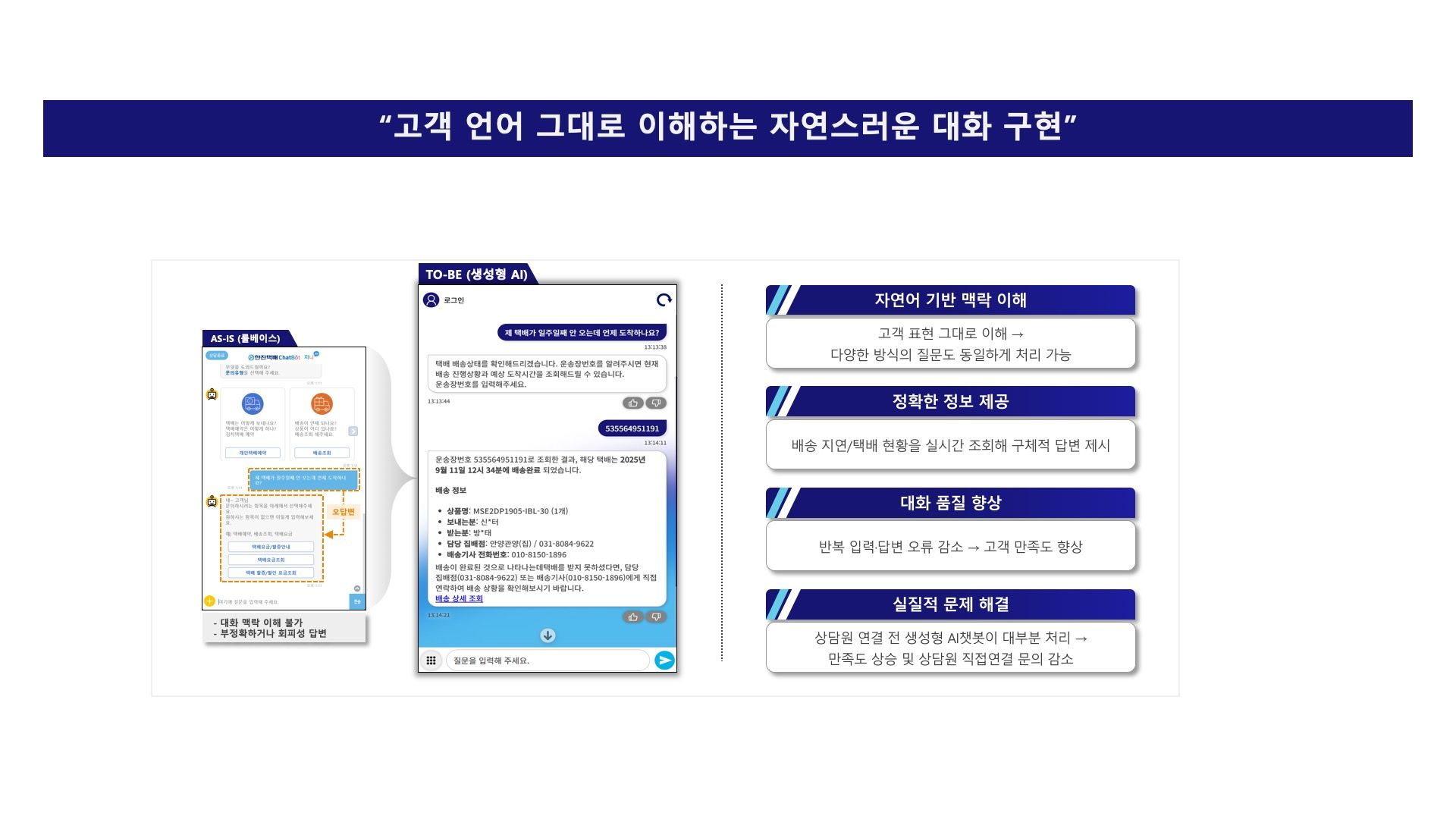
Improved natural language comprehension → Enhanced response quality
By understanding and processing customer utterances as-is, consultation quality has significantly improved, and customers can now obtain desired information faster.
Complex inquiries handled naturally based on context
Multiple stages of shipment and reservation processes can now be handled seamlessly in a single flow without interrupting the conversation.
Implemented automation chatbot that executes actual business tasks
Shipment tracking, reservation changes and cancellations, and return requests are now handled directly within the chatbot, greatly expanding the scope of "issues that can be resolved without counselor connection."
Accurate responses provided based on real-time API data
The GenAI Agent now combines information scattered across multiple systems in real-time to provide responses based on the most accurate and up-to-date data.
Reduced operational burden and improved management convenience
With automatic FAQ expansion, data-driven analysis environment, and flexible response structure without scenario modifications, the operational team's burden has been significantly reduced.